

The Great Prostitute

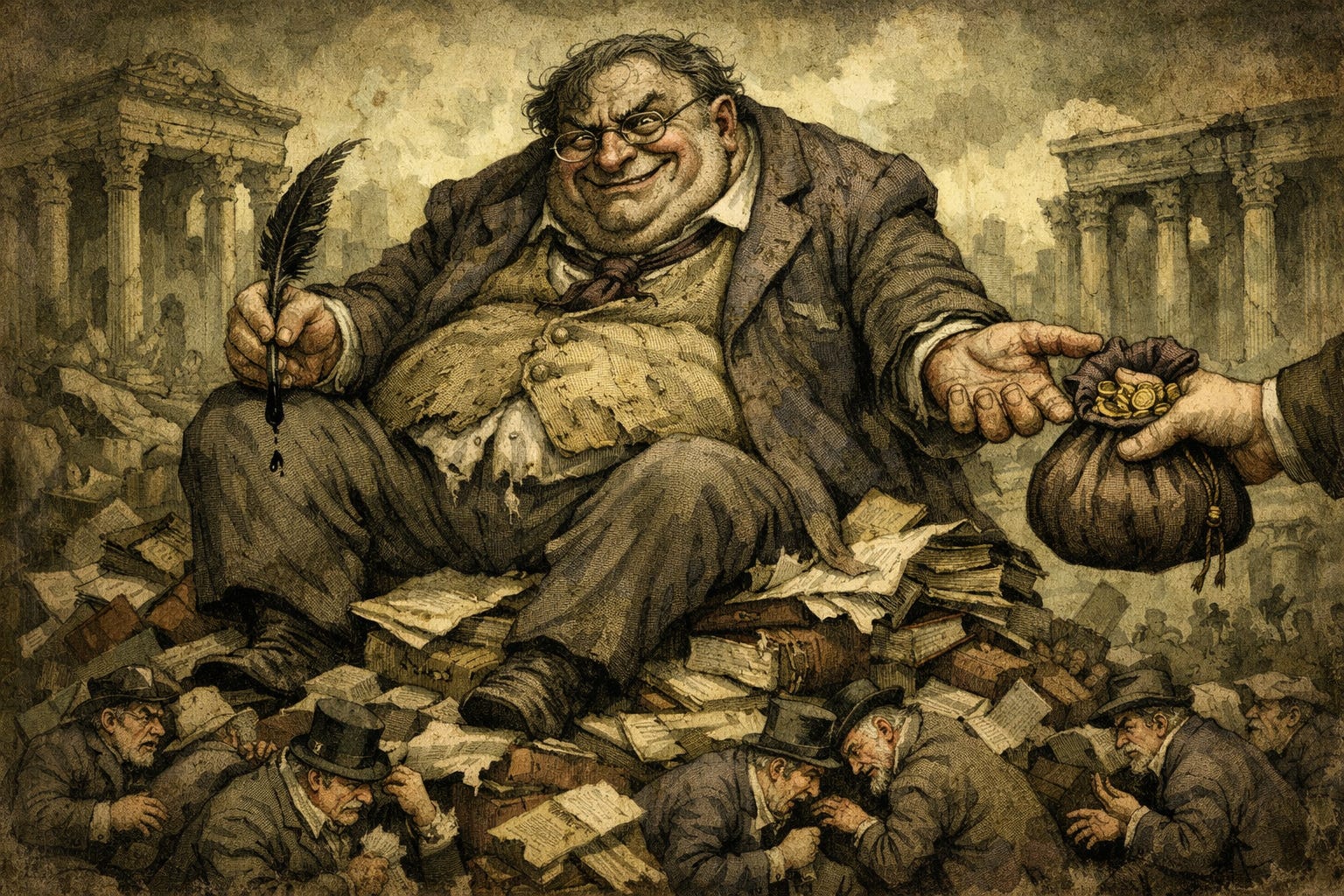
In these excerpts, Jean Cau insists, it is not the absence of progress; it is the masochistic embrace of self-destruction, the spectacle of a civilization that has learned to purchase its own humiliation and call it enlightenment.
Originally published in Éléments no. 3, January 1974.
Translated by Alexander Raynor
The Éditions de la Table Ronde have just published the sequel to Les Écuries de l’Occident (The Stables of the West). For this new essay, Jean Cau has chosen as his title: La grande prostituée (The Great Prostitute). The former secretary of Jean-Paul Sartre observes that intelligence is today sick, that it inhabits sick bodies, sick cities, sick societies. And he declares: “Life is right. That is not something one dialogues about. Our decadence is nothing other than the sharp and ferreting, impotent and garrulous, jealous and ironic triumph of the spirit that always negates. But if we do not affirm, others will come who, brutally, will dictate by force of yes their strength, their race, their past, their inheritances, their will, and their life.”
The decadence of the West is explained in part by a lack of will. What does scientific progress matter! “It is not because our societies travel to the moon and line up Nobel laureates in rows that they are ascending and in good health. Euclid, Archimedes, Theophrastus, Hipparchus, Herophilus, and a hundred others rose to the firmament of science just as Athens and Greek power were sinking into the abyss...” We publish here several excerpts from La grande prostituée.
Against the grain — à rebrousse-poil [Translator’s note: lit. “against the nap of the fur,” i.e., against the grain] — and against the received ideas murmured to us by the reigning intellectual utopianism, I assert quite calmly that decadence and scientific progress are perfectly compatible, and that just because our societies transplant hearts, travel to the moon, break the sound barrier, and line up Nobel laureates in rows does not mean they are ascending or in good health. Euclid, Archimedes, Theophrastus, Hipparchus, Herophilus, and a hundred others rose to the firmament of science just as Athens and Greek power were sinking into the abyss...
The Slices of the Cake
The gods die, and their former creatures strive to leave behind them a dropping — a book — by means of which they might leave some trace in the porous memory of men. On the divine corpse, the intellectual multiplies; his vanity fattens and swells on what he destroys. Bloated with rancid fat, complexion sallow, eyes ringed with shadow, he destroys, devours, digests, and farts out a book. A newspaper article no longer suffices; from time to time, he produces a somewhat larger turd.
There is something profoundly ridiculous about the gap between the tone of the works produced by our “intelligentsia” and the vanity with which their authors are puffed up like self-important frogs. Look at them: they offer up their photographs in newspapers and bookshop windows, appear on television, proclaim their print runs in vast advertising spreads, squint sideways at the curve of their sales figures, and deliciously inhale the fumes of glory rising to their pinched nostrils. Novelists, philosophers, essayists, journalists seized by the itch to write a book (and the dread of dying unremembered) — here they all are, squabbling over the slices of the cake that fame bakes weekly and annually in the fashionable ovens. Dissenters, decadents, revolutionaries, gurus of subversion, they agree in spitting upon a society of which they are the exquisite products, yet nevertheless ogle, from the corner of the eye, the medals of notoriety or petty glory that this strange stepmother pins to their chests, and accept no less readily the gold with which she fills their purses. While awaiting Utopia and groaning over the miseries of this world, why not play one’s life on two boards at once? Ideas on “pass” and daily life on “lack.” [Translator’s note: a gambling metaphor; in certain card or dice games, “pass” denotes a winning stake on principle while “lack” or “miss” denotes a hedge on the practical outcome.] One wins every time.
Cultural Terrorism
These remarks would amount to nothing more than polemic were it not that these intellectuals maintain a genuine reign of terror which, step by step, zone by zone, has spread like a leprosy across all the media — press, radio, television, cinema — that shape and condition the contemporary mind. They furthermore constitute an international caste whose members, in every metropolis of the West, occupy the forward positions commanding the gorges and passes from which it is easy to machine-gun and terrorize the herd, culturally speaking. I do not like this breed. I accuse it of trafficking in Utopia, whose amulets it sells spread out on the carpets of democracy. And, like any good trafficker, when the customer’s back is turned, it furtively counts the banknotes its business has brought in. Yes, everything is for sale in our societies — even egalitarianism and its preaching. Since nothing under the sun is entirely new, let us not forget that the Church, in its day, put a price on the indulgences that opened the gates of Heaven.
Howling with the Wolves
One must be made of stern stuff — and know that I sometimes admire myself for it — to resist the works and the pomps of decadence. To bail out one’s skiff each day rather than let the water of the age flood in. How easy it would be, O Lord, to howl with the wolves and raise the hoarsest cry of the pack. We would be granted talent. Our books would be praised. The herd would open its ranks and warm us in its fog of heat. Friendships would be bestowed upon us. We would speak the most widely spoken tongue instead of bleating, perched on our rock, our strange pidgin. We would be admired, fêted, received — and we would even earn a great deal of money, since the bourgeoisie today buys at great price the very gobs of spit with which its children or its bastards besmirch it. Its weary senses require the blows that bruise it.
Again! And again! Having failed to love the other and to give him an equal share of the pleasure we receive from him, let us grovel at his feet so that he may whip us and strike us. In the depths of abjection, at the lowest point of humiliation, our cry of pain, our strangled spasm, may perhaps resemble the death rattle of supreme bliss. With our gold — symbol of excrement, according to the good family doctor Sigmund Freud — we shall pay the prostitutes. There is no shortage of them. We shall buy them the finest boots and the most gleaming whips. When a society, a people, an empire, or a race is on the verge of sliding into the tomb, it is seized by this masochistic fury, this self-devouring hatred, this contempt for its own being. And it summons death as though death held the secret of the ultimate voluptuousness. So too the addict consents to inject the overdose that will strike him down, and watches the needle — conductor of the death philtre — sink into the vein. So too, in the family with the broken circle, the humiliated father gets down on all fours and no longer dares to raise his eyes toward the son who beats him senseless.
Such, however, is the situation, in the West, of our leftward-leaning left-wing intellectuals. They strike until they are breathless, but the Father offers up his back to the cudgel. And he pays! It is truly a hard task to be a sadist with clients like these!...