

McCarthyism: The Return

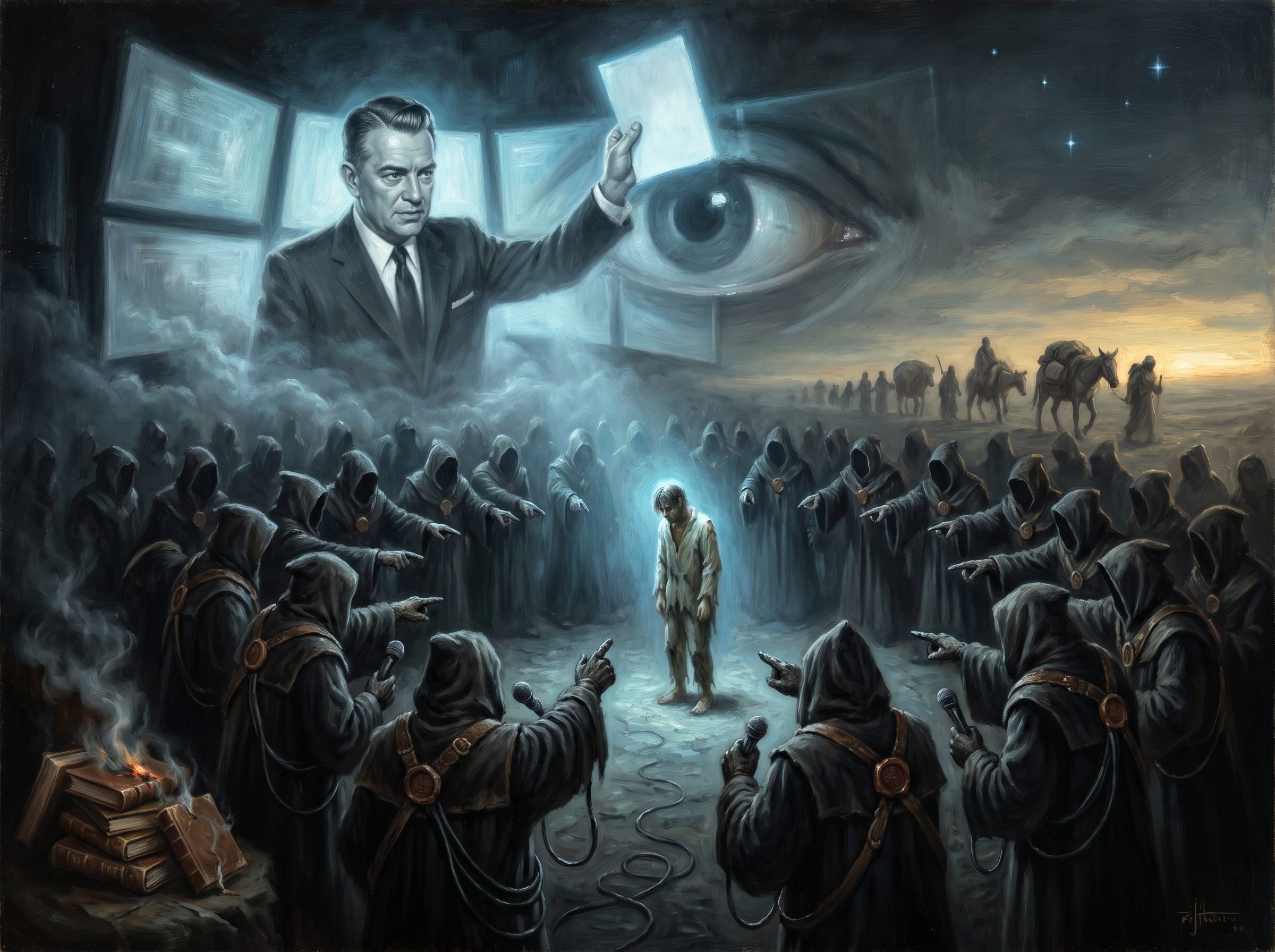
Alain de Benoist, as “Robert de Herte,” denounces what he sees as a revived McCarthyism in French intellectual life — a campaign of blacklists, "dossiers," and petitions aimed at ostracizing unorthodox thought and enforcing a homogenized pensée unique across press, parties, and television. Casting the new "vigilants" as self-righteous inquisitors and obsolete relics of a postwar world that has already passed, he insists that the answer to a false idea is not censorship but truth.
Originally published in Éléments no. 78, September 1993
Translated by Alexander Raynor
If the people who speak ill of me knew what I think of them, they would say a great deal more. (Sacha Guitry)
The witch hunt? It is upon us. The Inquisition? It is upon us. The Terror, the Law of Suspects, the cabal of devout zealots? They are upon us. The charter of neo-McCarthyism appeared in Le Monde on 13 July 1993. Its signatories propose, in the finest style of the political police, to “exchange information” and to circulate “dossiers” — in short, to put on guard against unconforming thought all those who, “out of scruple toward freedom of expression” (sic), or “out of concern for a tolerance without limits,” might be tempted to ignore them. We understand that they propose, in fact, to put pressure on publishers, journal directors, radio and television hosts, and the organizers of conferences, in the hope of bringing them to adopt their principles of exclusion. Gone is the time when the Beat Generation, with Allen Ginsberg and Jack Kerouac, could lay claim to Céline, Spengler, and Ezra Pound. Gone is the time when Malraux, fellow traveler of the French Communist Party, did not hesitate to write a preface for a book by Maurras. Associations of “vigilants” are now being formed for the purpose of media lynchings. Tartuffe and the Compagnie du Saint-Sacrement are back. The years of lead.
Are people aware that samizdats are now flourishing in Paris, on the model of those that circulated clandestinely in Russia under the Soviets? It is a sign of the times. In the East, anything can be said today. In the West, and in France in particular, the ostracism machine extends its grip in concentric circles. The major newspapers already form but a single one; the television channels are reduced to a single one; the principal political parties all share the same program. Everywhere, the system of single-track thought (la pensée unique) is being put in place. “That, on 80% of the great questions of the moment,” writes Jean-François Kahn, “a single cultural clan, sociologically and ideologically homogeneous, is able to concoct day after day a dominant, almost exclusive discourse, broadly diffused and amplified by audiovisual media that are more conformist than malicious — that is what constitutes today the essential question” (L’Événement du jeudi, 26 November 1992).
Some praise proportional representation as the best mode of voting. But where is it, this “proportional representation,” in the debate of ideas, in publishing, in research, in the media? “It is an entire cultural ensemble,” notes Jean-Marie Domenach for his part, “that finds itself increasingly hemmed in and controlled by a series of apparatuses, groupings, and cliques that impose a general conception, not only of history, but also of philosophy, art, and morality, and that ends, in reality, by creating a kind of more or less coherent ideology” (“La liberté d’esprit en France,” in Catholica, August 1992, p. 26). This ideology operates on a basis of pious thoughts, taboos, and obligatory deferences. “One could,” Domenach adds, “draw up a geography of what must and must not be said. And then, woe to the one who crosses the red line!”
Totalitarian regimes are rightly reproached with having censored and banned books. (Heinrich Heine: “Wherever they burn books, they will soon burn men as well.”) The new inquisitors operate no differently. By a classic mirror effect, well described by Pierre-André Taguieff (the “racialization of the presumed racists”), they employ all the methods they believe they can attribute to their adversaries. They reason in the manner of conspiracy theorists. They point the finger at scapegoats. They institute ideological segregation. In the name of liberty, they sign petitions demanding the suppression of evil thoughts; they organize exclusion in the name of tolerance; they incite hatred in the name of humanity. Rather than refuting ideas, they call for censorship and prohibition. They defend sociological pluralism, but they refuse the pluralism of ideas. And if they deplore “ethnic cleansing” in Yugoslavia, it is only the word “ethnic” that disturbs them: cleansing as such does not trouble them for an instant. Against the “satanic” prose of those who have the audacity to mock their dogmas, the valiant supporters of Salman Rushdie, transformed into ayatollahs of the concept, no longer hesitate to fulminate their fatwas.
By making use of such procedures, our singular “vigilants” obviously lose all credibility. This, in fact, is what is now being said all across Paris, where people have understood quite well what they are: functionaries of social-liberalism, watchdogs of the established system. Deluded men whose fantasies serve to mask the reality of the existing system of oppression.
In truth, they are pitiful, these combatants of the past, partisans of an “antifascism without fascists,” who have forgotten that the answer to a false idea is not called censorship, but truth. They have not yet understood that the postwar period is over, and that their references are so many distorting filters that prevent them from seeing the reality of the present time. They have not understood that fascism and antifascism, like communism and anticommunism, are equally obsolete, and that the somber light still emanating from them comes from stars that have ceased to exist. A new world is being born, with new themes and new cleavages. Mired in what Thierry Maulnier so aptly called their “Old Regime polemics,” they confront this new world with dark glasses and forbidding signs. B.-H. Lévy, who nonetheless sympathizes with them, confesses that, in reading their manifesto, he could not help reflecting: “Here is a small troop that has neither thought nor program, neither project nor, as we sometimes say, utopia” (Le Point, 17 July 1993). Dinosaurs. The new inquisitors stiffen, because they sense that their world is in the process of disappearing, that their points of support are crumbling, that they have nothing left to say at the very moment their debacle is announced. They see that everything is cracking on all sides, and they know that in the world that is taking shape they will have no place. So they cast off the mask and cry out: “What are the police doing?” Meanwhile, the caravan moves on.